
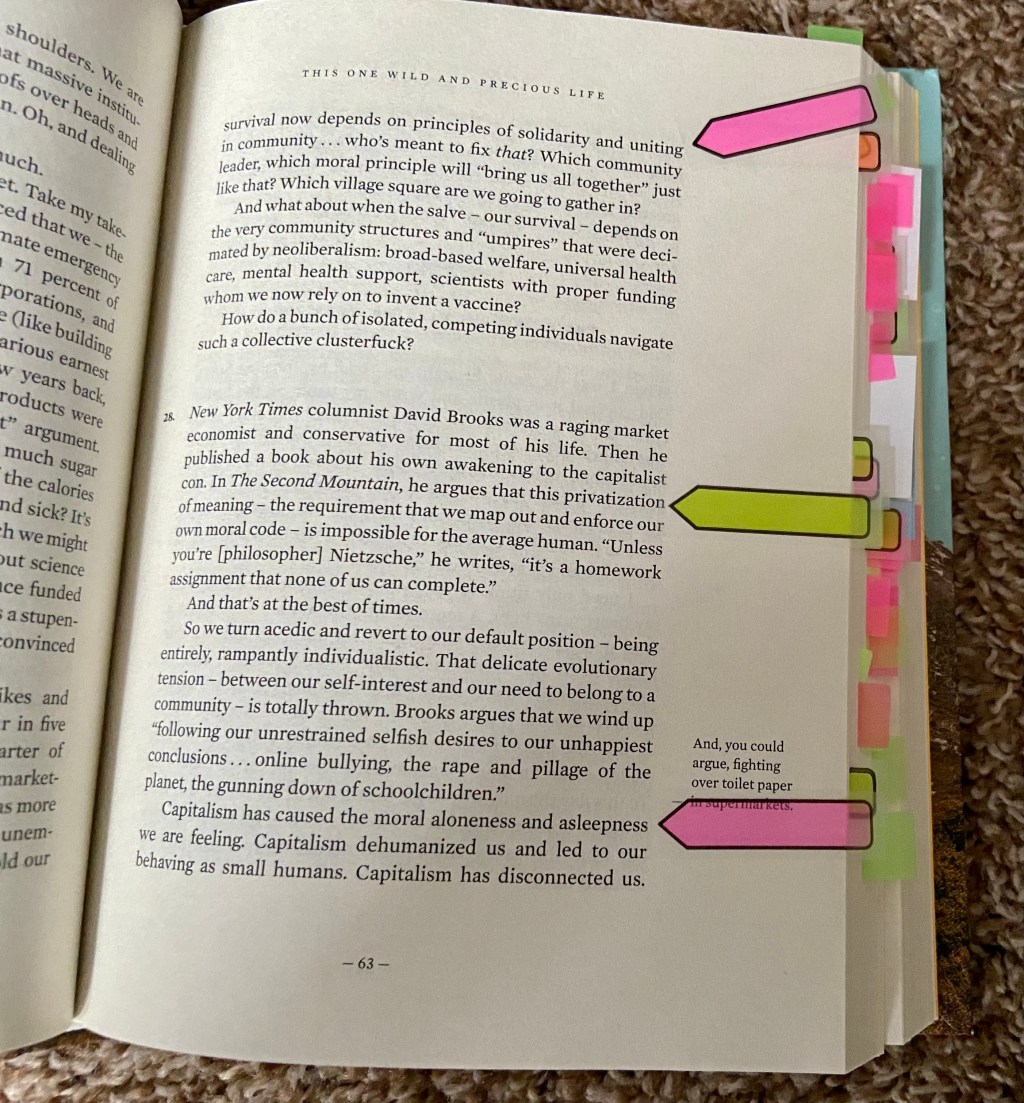
I always urge every student I teach or tutor the power of marking up a text. I even try to tell them that doing the hard work up front saves you time in the end. I’m reminded of a high school student who had to write a paper on a book he read but seemed depressed about the difficulty of the task considering that he couldn’t recall anything about it.
On the other hand, I get giddy when I notice students marking up their texts. You can tell the ones who do it regularly from the ones who don’t.
I don’t know if I was ever formally taught annotation. I only know that I can’t not do it. The compulsion to write or to grab a page marker or to underline gives me a literal itch that can only be scratched by putting my thoughts to the paper or putting a mark on the page.
Personally, I eschew highlighters, preferring a pencil, but still marking a page even if the only thing beside me is a broad nib fountain pen. Recently, I’ve been making the effort to use my library more, which means that how I read looks a bit different. While I can go into how I mark up my books, I wanted to talk about how I do it in library books first.
The tools
- Page markers. Preferably the arrow kind for more precise pointing.
- Page tabs for sectioning books for records
- Small sticky notes for writing
- Regular post-it notes for lengthier responses
- A pen or pencil
- A book mark
- Reading journal. Mine is a black XL Moleskine Cahier notebook.
The method
Mark everything that looks of interest with a page marker. You can decide later, once you’ve finished the book, if that quote you marked is worth putting in your notebook. In the meantime, don’t get bogged down in whether the quote is “good.” If it stood out to you, made your heart palpitate, or made you have some sort of emotional reaction–mark it. I recently started to use colors to differentiate ideas:
- Pink for quotes
- Orange for stylish writing
- Green for concepts to explore further or book recommendations
- Blue for blog post ideas
These categories sprung up out of need. I only make categories if I need to do so.
Always stop to respond if the urge strikes. If I can make a connection or show a contrast between another book, I use a small sticky note to do so. If I get angry at something the author said, I usually go for the regular-sized post-it note. Sometimes I write briefly. Sometimes I don’t.
I sometimes time my reading. This isn’t because I’m in a competition, but mainly to observe my reading speed and stamina. If there’s a book I really want to finish, I can guess how fast I might be able to read it based on the individual format of the book. I never do it based on any other book. For example, Stolen Focus by Johann Hari was a fairly large book that took me six days to read even with the longest of stamina and concentration. There were a lot of words on the page and the font was small, too. In comparison, Things That Matter by Joshua Becker didn’t take as long because it was a smaller, thinner hardcover even with font of around the same size. I use thin page tabs to do a “start and stop” of 20-minute reading intervals when I’m in the mood. With my current book, this one wild and precious life by Sarah Wilson, I can read about 12 pages in 20 minutes even as I stop to tab or write my thoughts. I also use page tabs to set individual daily or weekly reading goals. I really am enjoying Wilson’s book, but don’t want to take as long as I did with Stolen Focus because of the other books I’m also itching to read. **
**When I originally wrote the draft for this (about a week ago), I had a lot of energy. Now, a week later, I do not because of mysterious fatigue, and I’m still on the struggle bus to maintain my reading stamina and finish the book. I’m giving myself a lot of grace at the moment.
The reading journal
After reading a book, I don’t immediately jump to the reading journal. I don’t immediately de-tab or un-stickie books even after writing about them in my journal. Sometimes I set them aside to give my brain thinking space. Sometimes I just want to start on the next book. But I am making it a habit to ALWAYS return to my reading journal.
Before I would use Goodreads. I do like Goodreads; however, I find it doesn’t suit my needs for in-depth thinking on the books I read. It’s also awful at collecting ideas and quotes in a format I like. My reading journal is based off of the reading journal of a Japanese college student I found on YouTube.
In the journal, I include a picture of the book, the title, the author, and a synopsis of the book. I usually will just handwrite the synopsis word for word. Then I include quotes of interest, and I’ll even include my responses to those quotes if I have them. That also gives me a chance to elaborate on my initial thoughts to those quotes. Some quotes are a sentence. Some quotes are an entire paragraph. After that, I’ll include my impressions of the book. This means that each book entry varies in length. Starfish, a middle grade fiction novel, took up one page. Stolen Focus took up several pages–front and back. Some books might just take up half a page.
As I mentioned, even after I complete a book entry, I don’t always de-tab library books. This means that I still have more that needs to digest, perhaps what comes out will be a blog post or just end up in my private journal or shared with friends.
I’ve contemplated including actionable items in a notebook on their own (or within my book journal) based on a blog post I read. I can’t recall the blog post specifically, but I like the idea that with books that call for action, a really good way to apply what you learn is to create actions from those books. If you read a book on investing, maybe you’ll choose 1-3 actions based on what you read, such as getting a financial advisor to help you set up some sort of fund or simply increasing your retirement contributions. If it’s a book on kitchen organization, maybe the action you take is to finally declutter the junk drawer next to the sink. Some books aren’t so obvious in their actions, but they can still be actional. For example, in “this one wild and precious life,” I learned about the Greek word “acedia.” An actionable item might be to read further about this idea. In fact, I gave it a green page marker so that I could.
Over time, my process will change as it refines itself according to my needs, but this is how I currently read library books and “mark” them with lots of stickies.
 Cafe + Lit
2 responses to “How I Read”
Love this. I’m a stationery/journal enthusiast who also loves reading, so this is right up my alley. Have you tried those see-through Post-Its? Those are miracle things, allowing you to mark up your book without actually marking them up. I also have no qualms about marking up books if they’re mine though. Makes the reading so much more two-way.
LikeLike
I do have some and do not use them (for no reason really). I’ll have to find where I put them and use them as I have two sizes of them definitely suitable for underlining. Thanks for the reminder!
LikeLike